Thursday, October 23, 2025

Kabocha Squash Ravioli in Lemon Butter Caper Sauce


If you peel, chop and cook down a great kabocha squash, just a little butter, nutmeg and maple sugar, some water so it doesn't burn. Let it go for an hour or so stirring often until a thick paste. 

Then roll out dough and make ravioli with that. Cover in a sauce of butter, lemon, egg and capers. As simple as it can get. Just exquisite. 

I'm told this is one of my signature dishes. I've been doing it for about 30 years. It's so labor intensive that I don't do it often and every time I try to do a quicker or easier version, it just doesn't work. 

So it must all be done by hand. 

Friday, February 7, 2025

Breakfast Noodle Soup


Every other day I make noodle soup for breakfast. I add slightly different ingredients, use a slightly different technique or something different each time. Every now and then they flop. Usually they're good, sometimes exquisite. And there's no inherent logic to the rate of success either. Handmade noodles, homemade stock, fresh ingredients sometimes yield a superior soup. I keep stock in the freezer for just such occasions. But just as frequently I'll use store bought ramen and soup it up, so to speak, with other ingredients. This base of Neoguri Nongshim's seafood udon is remarkably good. Coconut milk, lime and tomatoes make it sublime. A little chickua or fresh fish is fantastic. Even canned clams works great. This is sort of like oyakudon, made with strips of marinated pork shoulder, dusted with tapioca starch and when simmered in a pan with shallots and dashi stock for the same 3 minutes it takes to cook the noodles. At the end a beaten egg is poured on top and then covered to steam for a minute. Finally it's all tipped into the soup, which also contains baby bok choy. It sounds a little complicated, but actually it takes 10 minutes or so, which is why on days I teach this has to be quick. I'm out the door around 7:00 AM and walk for an hour and a half on my way to work. 

This is actually an experiment. Do blogs still exist? I started a substack and not sure I really want to use it. But obviously I haven't written anything here for a year. Let's see is anyone looks at this other than bots. 


Monday, January 8, 2024

My Sycamore

Another selection from Food, Clay, Wood 


A grand sycamore stood sentinel by the sidewalk at the front lawn of the colonial revival house where I grew up in central New Jersey. The entire Levitt planned community was planted with this and a handful of other species, and they must have been fairly large in 1967 because I could easily climb them a decade later. I would hang out in one particular sycamore along the sidewalk. It had low limbs, evenly spaced, and was very easy to hoist up and into. I went as high as I possibly could, hugged the main trunk and let it sway in the breeze as I twisted along with it. My neighbors claimed that I would sing opera up there, which may be true. Eventually I nailed a plank of wood into the main V-section about 20 feet up as a seat. It’s still there, the wood grew around it, and 45 years later is almost completely engulfed. The lowest limb is now maybe 40 feet up; it’s a massive tree today.

What I liked most about my tree was its resonance. You could rap any limb, with your ear up against the bark and it would offer distinct mellifluous tones. You couldn’t get a conventional scale out of it, but definitely worth slapping and knocking. I like to imagine that the tree knew me, responded to my moods, maybe even hugged me, as I definitely did its limbs. I came to know that strange mottled bark so intimately and even saved pieces as they peeled off.

After college, when I moved home between degrees, I spent more time in the tree. I wrote up there. I even threw parties in it. At one point there were 6 or 7 people in the tree, drinking cocktails hoisted up in Ziplock bags, and snacks in little bowls. I started dating the woman who is now my wife right up in that tree. I went away of course, eventually so did my parents, literally. Until recently, I still visited the tree, thousands of miles from the other coast where I live now. The last time I saw it was long before I started carving, and a limb fell off. I took a few tiny pieces. What I would give now for that whole limb! Sycamore, as it turns out, is utterly gorgeous wood, with a clear set of rings, but also tiny vertical lines cutting across them that create a gorgeous pattern in carved wood. Even the smell of that tree I think I could recognize blindfolded.

I say all this because I think people can have very intimate relationships with other living beings that don’t react like pets, but in a very different primordial way. When I encounter a huge old copper beach or a valley oak where I live now, it’s more awe inspiring and intense than seeing a large animal. Just knowing they were alive hundreds of years ago thrills me. In the case of the towering redwoods in the California foothills, they were around at time of Plato. They stand as living witnesses to the past - if you are willing to listen.

I say all this because I have a deep empathy for wood. So it felt strange the first time I carved it. Some trees have deep pink striated flesh that resembles tuna or rare beef. Sometimes wood will be so fresh and wet that it seems to bleed, or practically splashes with the fall of the axe. This isn’t a bad feeling. It’s no different than butchering an animal. I’ve never killed a large mammal but taking one apart I truly enjoy, cutting around the bones, following the sinews connecting to muscle tissue. The same is true of wood and its own internal structure. When a limb falls down in a storm, I’m happy to make use of it. Or when a tree needs pruning.

That’s exactly how I got into carving in the first place. Two olive trees – Scylla and Charybdis, so named because I planted them too close together. Today they not only can’t be disentangled, but steering between them is treacherous, especially when trying to pick the olives. A really low branch needed to come off as it stuck out over the sidewalk, and I thought, this is such nice wood, something must be done with it. I had absolutely no idea what I was doing. I had a pocketknife. And I so wish I hadn’t ruined so much of that beautiful wood. But a few of these early olive wood spoons I still use. It carved so wonderfully that I believe I have never worked with a finer wood.

All this is to say that a tree you know well, have harvested fruit from, see every day perhaps, or best of all planted with your own hands, is one whose wood you will respect and cut with care. Even those in my neighborhood, I treat with a certain reverence, and knowing full well that a branch will end up chopped and used as compost, gives me great satisfaction knowing something else might be done with it. At times I’ve been tempted to knock on people’s doors, not to ask if I could take some wood, but to say I already did pick up a branch on the curb, and carved it, and here’s a spoon, thanks so much. There is actually no feeling better than giving someone a spoon or anything handmade for that matter, and knowing they will be using it for a long time to come.


Wednesday, November 9, 2022

Food Clay Wood: An Excerpt


This week I started writing a new book, and I thought I'd share a brief essay from it. Here goes: 


Beauty and the Graceful Line


It sounds a little silly nowadays to be talking about Beauty with a capital B in universal terms. We are so used to setting everything in historical context, being careful to understand the culture that produced an object without our own blinkered prejudices. We do this for good reason: it’s difficult to escape the way our own culture shapes our judgement, since we are so embedded in our own time and place and so swayed by the forces of fashion. We are hesitant to judge at all after so many centuries of revering great masters as canons of taste. Swinging in the complete opposite direction, the Romantics insisted that only the direct imitation of nature, even if gruesome, can serve as an objective standard, that which evokes emotion because it strikes us at the core without the intervention of intellectual rationale, or taste – which is just a byword for status. This was the complaint the energetic Baroque had with the cool intellectualism of 16th century Mannerism, and how 19th century Romantics rejected the Enlightenment, by turning to nature.

Nature does indeed offer lessons for craft, if not precisely in the way a painter approaches a landscape or a human body. We find objects beautiful precisely because they are well fitted to carry out specific functions. In nature, a flower is beautiful because it offers color, aroma, inviting form to the bee, who finds it beautiful and spreads pollen for the plant. WE find it beautiful for the same reason, though of course with added cultural baggage.

So too is there beauty in objects. It is not so simple that form should follow function as architect Louis Sullivan insisted, but that certain material dictate certain shapes, or they simply collapse or refuse to work. A teapot may be gorgeous but if it doesn’t pour, it’s not a teapot – I’ve made a few of those. It may be art, but that’s an entirely different topic. Here I am concerned with the relationship between objective standards of beauty and the utility of everyday objects. If we simply say everything is beautiful, then there are no standards and we are subjected to hideousness and filth.

What then constitutes Beauty? Let’s begin with the line. They come curved, straight, bent, twisted and curled. Each exists in nature and for quite specific reasons. In my own backyard there are grape vines that stretch out and tightly grab anything with little curled tendrils that support the plant’s desire to stretch outward. The leaves thus achieve maximum exposure to the sun, and the result is sensuous curvaceous vines. The bamboo has an entirely different strategy, it busts straight upward as fast as it can in a week or two growing 50 or 60 feet, and then pops out leaves that are so high up, nothing can shade them. The higher it goes, the thicker the stem needs to be and some can be a foot in diameter. Each is beautiful in its own very unique way.

Leonardo da Vinci appreciated this. He drew the swirls of the horsehair equisetum plant and wondered why the whorls were similar to the eddies in gushing rivers, and the flow of blood coursing through our bodies. I think he was considering precisely what physical properties can be considered universally Beautiful. Skeptics of course will point out that appreciating such forms is a cultural value, even nature itself is culturally constructed. What one people find beautiful is strange or meaningless to another. The Enlightenment philosophe Voltaire quipped about this in his Philosophical Dictionary when he asked what is the To Kalon, or ideal form of beauty. To a frog it’s a green complexion and bulging eyes. He was calling for a relativistic approach, to each his own. But Voltaire entirely misses the point, that frogs are eminently beautiful – their slippery skin, their bulging legs perfectly designed for jumping, their circumspective eyes.

How does this relate to human made objects? Let’s turn to pottery. If you lift the walls of a clay vessel, either wheel thrown or hand built, straight upward, eventually the form will twist and buckle and then probably collapse. To prevent this you have to make the walls so thick that the vessel is blunt and too heavy to use. But if you give the pot a shoulder or hip (ceramic forms are often anthropomorphized) so it bulges toward the top or bottom, the pot gains structural integrity. But it also becomes beautiful, the line becomes sensuous, much like the bend of a spoon, and it becomes stronger, lighter and more functional. An acute angle in a pot wall or spoon compromises its use. A bent spoon will spill soup in your lap. A pot that flares out at the top too sharply will flop down through the force of gravity. The “well wrought urn” is not curved because that’s the way the Greeks did it, but the Greeks did it that way because they had to. So did the Chinese masters of the Song Dynasty and potters of Seagrove, South Carolina. The vase turns out to be a great example of Beauty.

I hear your objections. Aren’t there awkward angles in pots, and forms intended to disturb or shock the viewer/user? Obviously in museum art, but I’m not so sure about utilitarian wares. Think of food, it must be palatable, meaning it can’t contain sherds of glass or metal, and it can’t be laced with arsenic, or it’s no longer food. But don’t some cultures adore foods that others abhor? Yes, but anyone can learn to overcome those culturally learned preferences, just like they can learn to like coffee or whiskey, or unlearn our instinctive predilection for sweetness. I mean, a baby would happily eat a worm if offered by a parent. Does that mean that there are some foods that are universally Beautiful for all cultures and all times in history. Of course there are, just as there are dreadful foods people learn to love – I’ll take a marshmallow peep or gummy candy any day.

I argue that certain flavors, combinations of ingredients, cooking and preserving methods are universally tasty. Maybe some don’t like too much heat, or are genetically averse to cilantro, but think of that innate preference for sugar. Or think of how smokey flavors are hardwired into our limbic brain after millennia of  cooking over fire. Or even take a food spread around the world – like pasta, which is universally Beautiful. If anyone tells you they don’t like pasta, they are either on a low carb diet or lying. I would say the same for an elegantly sloping bowl, just holding it in your hands gives instinctive pleasure, as does the graceful arc of a well carved spoon. These transcend all time, space and cultural prejudice.


Tuesday, November 8, 2022

SPOON CARVING

I realize I haven't posted in months! This is what I've been up to. Carving spoons. It took me a long time to get decent at it. Today I counted, 80 spoons so far since the spring. I intend to get a book out of this, provisionally called FOOD CLAY WOOD. I just started writing. Stay tuned. In the meantime the Gelatin book is in the warehouse and ready to be shipped! And the cookbook now entitled OPULENT NOSH is about to be contracted. All ready to go. 


Monday, February 7, 2022

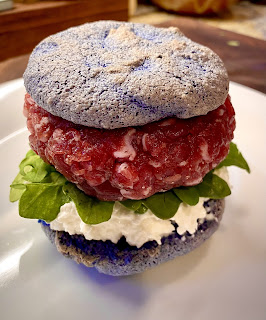
Macaron Tartare avec creme de raifort et roquette


 My first shot at macaron and a bit lumpy, no smooth top and no "legs" but they taste very good, with raspberry jam everyone ate them happily. But mine I filled with this chopped filet mignon. It has very little flavor when cooked as a steak, only softness. But that makes it ideal for eating raw. 

The sweet almond flavor of the macaron with meat makes me think of medieval flavor combinations, and if there had been a little spice to it, definitely so. As it was, the compliment of the bitter green and pungent horseradish went perfectly. 

Friday, November 19, 2021

Tacoyaki


I can't imagine I'm the first person to stumble on this wordplay, but the flavor combo is truly delightful. Takoyaki with octopus of course, in a taco with pico de gallo, cheese, mayo and sauce on top. 

Wednesday, August 11, 2021

Plum Crumble in Bourbon Campari Jello with honeyed yogurt.


Recipe: 1 c whole wheat pastry flour, 1 c unrefined sugar, 1 stick butter. Crumbled up. 4 sliced black and green plums on top, baked 350 1 hr. 3/4 c bourbon, 1/4 c campari, 1 tbs gelatin. Dissolve gel in 1/4 liquid, heat the rest, pour over, let cool. Pour over chilled pie. Chill. Dizzyingly luscious. The bottom is like a sugar cookie, crunchy on the outside and chewy inside.

Friday, June 25, 2021

Lobster and Noodles


 There's a first for everything in life: Leftover Lobster. It called to me from the fridge all night. So I gave in, made some fresh egg noodles, tossed with butter, parm and a little lobster stock. OH my goodness! 

Tuesday, March 23, 2021

Chawanmushi Improvs


This is a kind of Japanese custard which people think requires some remarkably complex technique. It’s actually easier to make than a poached egg. Its appeal lies primarily in the soft creamy texture, especially when contrasted with crunchy or chewy garnishes. In flavor it can be as delicate or as intense as you like in the morning, and is entirely dependent on the strength of the stock you use. The key to success, I discovered after much travail, is adhering to a simple formula and precise timing and after that you can use any ingredients you like. Here is a relatively classic version, though garnished according to my personal whim.

½ c dashi stock
1 jumbo egg
½ tsp mirin
½ tsp soy sauce
2 small pieces of lightly salted salmon

A few whisps of dill, Thin wedge of tomato, 1 shiitake mushroom, 1 tsp neutral oil

 If you can make dashi stock, by all means do. It is a handful of skipjack mackerel shavings and a piece of kombu steeped in hot water and strained. You can also find powdered dashi stock, just try to avoid the jarred instant hondashi powder. Put 3 inches of water in a small pot and bring to the boil. Break the egg gently into the room temperature stock, and stir with your finger. On no account should you beat this mixture, or you’ll have spongy scrambled eggs. Add the mirin and soy. With a small fine meshed sieve set over a small teacup, press the mixture through. This takes a few minutes, so be patient. Cover it with tin foil tightly. Lower the heat of the water as low as it will go, and place the tea cup in the pot and cover. Steam for exactly 12 minutes. If the water is over 170 degrees, the liquid stock will be pressed out of suspension and you’ll have wet scrambled eggs. Do don’t be tempted to turn the heat up or even peek at it.

Meanwhile cook your mushroom in oil, and char the tomato too, then set aside.

Remove the teacup from the pot and let rest 3 minutes. Remove the tin foil and arrange the garnishes on top. Serve at once with a spoon while still warm.

Now here’s the best part, you can use absolutely any kind of stock and any garnishes you like. An intense mushroom stock was remarkable with sour cream and chives and a few sliced of truffle for extravagance. Chicken stock was incredible in custard form, especially contrasted with crunchy sweet corn fried in butter, with a few chewy chicken meatballs to garnish. A shellfish stock with shrimp would be so delightful too. I leave this to your imagination. 


Friday, January 15, 2021

Amaranth Sushi with Smoked Trout


Amaranth Sushi 1/15/2021

Some grains simply don’t stick together well enough to hold together in a rolled sushi, but amaranth is an exception. The nutty flavor also goes so nicely with the fish that it doesn’t need any further embellishment.

¾ c water

1/8 tsp salt

½ c amaranth

1 smoked trout filet

1 tbs mayonnaise

2 sheets of nori


Bring the water to the boil in a small pot with the salt. Add the amaranth and lower the heat. Simmer very gently for 20 minutes covered. Remove the lid and let the steam rise in the hot pot, stirring now and then, until the amaranth is completely dry and cool. Mix the trout and mayonnaise. Briefly pass the sheets of seaweed over an open flame for just a second so they are toasty and crisp. Divide the amaranth between the two sheets and make a thin layer. Place the trout in a thin line along the middle. Then place the whole thing in a sushi rolling mat, and roll up tightly, pressing it in with the edge of the mat rolled around it. Remove the whole roll, cut into 4 parts with a serrated bread knife, very gently so you don’t squish out the contents. Repeat with the other sheet. Makes 8 small pieces.


Sunday, December 27, 2020

Sev Nachos

 Among the most ingenious ways to transform chickpea flour is to extrude it through a brass device used in India to make sev – a kind of fried noodle that goes into a variety of dishes. There are various other machines that will work just as well, a small hand-held noodle extruder, a ricer and even a cookie press with a perforated die. Here I have obviously desecrated a revered snack food, but it is so remarkably delicious, I implore you to try it.

  • 1 c chickpea flour
  • 1 tsp vegetable oil
  • ½ tsp salt
  • ½ tsp turmeric
  • 1/8 tsp paprika
  • 1/8 tsp cayenne pepper
  • Water (less than ¼ cup)
  • 2 inches of vegetable oil in a pan
  •  

  • 1 ounce mozzarella
  • 1 Roma tomato
  • 2 tbs sour cream
  • ¼ c fresh cilantro
  • 1 tbs milk
  • 1/8 tsp of salt


Mix the first 6 ingredients and add just enough water so it becomes a stiff dough. If necessary add a little more chickpea flour and form into a cylinder with your hands. Slide it into your press. There is no need to oil it, your hands, or anything. Now heat your oil in the pan. To test take a tiny bit of the dough and put it in the hot oil. See if it floats up. If it sinks and no bubbles form, it’s not hot enough, if it browns quickly, it’s too hot. Adjust heat accordingly. Then put the plunger in your extruder and turn the crank directly over the oil, filling the whole pan with noodles. With a pair of metal skewers, start turning them over. Cook on both sides about 5 minutes or until golden. Remove with a slotted spoon or strainer and place on paper towels to cool.


Then arrange on a baking sheet covered with tin foil, sprinkle on the cheese and the tomato, chopped. Place in a toaster oven at 350 degrees until the cheese is melted. While that is heating, mix the sour cream, chopped cilantro and salt, thin with milk until it’s pourable. Take the nachos out of the oven a drizzle with the sour cream mixture. Be forwarned: it’s awfully messy, but there’s no other way to eat it but with your fingers.


Wednesday, November 25, 2020

Boyos (Sephardic Rolls with Rabe and Feta)

“My grandma was the best cook ever!” says anyone who has ever been interested in cooking and eating. I say the same thing myself. For years I have been trying to replicate her recipes from memory. She died when I was 13, so it’s mostly guesswork. One of these is boyos – a kind of round roll with spinach and feta filling. There were also other fillings, like onion and egg, ground beef too. I recall vividly one day exclaiming how much I liked them, so whenever I saw her, she would have made dozens just for me, to put in the freezer and have for breakfast every day. In all honesty, they were a bit dense and since she was Mediterranean at heart, she poured olive oil on top. My father would become incensed; he liked them fine without oil, but she insisted.

After a little sleuthing I found that boyoz, as they are spelled in Turkey, are still made in the city of Izmir (Smyrna) where my grandmother’s family came from, and they are still associated with the Sephardic Jewish community. Of course the name is bollo – and they come originally from Spain. They are often unfilled in Turkey and are made of a pulled filo dough, light like a croissant. Nothing like my grandmother’s.

So with this recipe I thought about how much better they would be light and flaky, so I made a simple yeasted and laminated croissant-like dough with butter. I also used broccoli rabe instead of spinach, because the oxalic acid in the latter strips the enamel off my teeth and makes them feel chalky. And because rabe is the best vegetable on earth, period. Use a good creamy feta too, ideally from Bulgaria, but French feta can be great too.   


1 c pastry flour
1/8 tsp sea salt
1 tsp instant yeast
1/3 c water, plus a little more for kneading
6 tbs salted butter
1 bunch broccoli rabe
3 tbs olive oil
1 tsp salt
6 oz feta cheese
1 egg
1 tsp each black and white sesame seeds


Mix the flour, salt, yeast and water and knead for about 10 minutes, keeping your hands wet with extra water (rather than dry with flour). Place pats of the cold butter on a sheet of plastic wrap and put another sheet on top. Roll it out into a thin square. Roll out the dough on a large wooden board, this time floured. Remove the top sheet of plastic from the butter and set it directly on the dough; then remove the other sheet. Fold the dough over the butter like a book and roll out. Repeat folding over and rolling out 4 or 5 times more, wrap the dough in the plastic and let rest in the fridge for an hour.

Chop the broccoli rabe, discarding the thick ends of the stems. Fry in the oil and season with salt. Cook over medium heat, stirring now and then, for about 15 minutes. Remove from the pan and place in a bowl to cool. Then crumble in the feta and add ¾ of the egg. Mix well. And set aside until the dough is finished resting in the fridge.

Roll out the dough on a floured board. Cut into four pieces. Place the filling in the center of each piece and fold over the sides, encasing the filling. Then turn them over, so the top is smooth. Brush with the remaining egg and sprinkle with sesame seeds.

Then heat the oven to 400 degrees. Bake the boyos for 10 minutes and then lower the heat to 350 and cook another 20 minutes until browned. Eat them hot, for breakfast of course. 


Thursday, October 29, 2020

Recipe Testing


How to do Recipe Testing


First get on your sturdy hiking shoes and a good hat and a little blue backpack from Disney Word with Oswald the Lucky Rabbit on it. Set out early, but not too much before stores open. Head north. Don’t forget your earbuds. Prepare to spend about 4 hours listening to Trout Fishing in America, which will lull your brain into a state of hypnosis. This will help you focus on the recipe at hand, still as yet unimagined. Drop into a little party supply store that is almost always closed, and for no good reason buy a few 3-inch tinned brioche molds for $2.40 each. Keep going north. Stop in the famous San Francisco Boudin Bakery chain, which you haven’t been in for about a decade, when your son was taking guitar lessons and the other son wanted clam chowder in a sourdough bowl. Buy some sourdough and wonder, as always, how that the particular lactobacillus strain can survive the heat of Stockton. Keep walking north. Imagine stuffing the bread into the brioche molds. Pick up some vodka (best to plan ahead) and put it in Oswald. Buy some olive oil, the last drop of which you used last night. The backpack will begin to sag by now. Richard Brautigan will make you say Trout Fishing in America when the person at the cash register asks if this is credit or debit. When you finally get home, cut the sourdough into thin three-inch rounds with crust all around. Butter every surface, including the sides, your hands, and the top of your head. Suddenly remember that although you have no trout, there are chunks of salmon, well salted, strewn with dill and splashed with Linie Aquavit, which is better than any other because it has crossed the equator. Unlike the salmon, who only went upstream. But they didn’t have a ship, which is why they die after spawning. The people who bring Linie Aquavit across the equator, they do not die after spawning. Squish your buttered bread, but not your head, into the brioche molds and fill with a few nubbins of cured salmon. Nibble on the salmon, then remember that you put the vodka in the freezer and make a drink with lime, sugar and lime-flavored seltzer so you can bear out the 15 minutes you arbitrarily decide will be the time this recipe takes to bake. Preheat the toaster oven. Crack and egg, add a pinch of salt and pour into the molds. Whisk the brioche molds into the toaster oven and sip your cocktail. When the bell goes off, remove them, take a few pictures and pry them out of the molds and take a few more. Eat the whatchamacallits with your cocktail. Oh just call them Trout Fishing in America. Mayonaise.

Friday, October 16, 2020

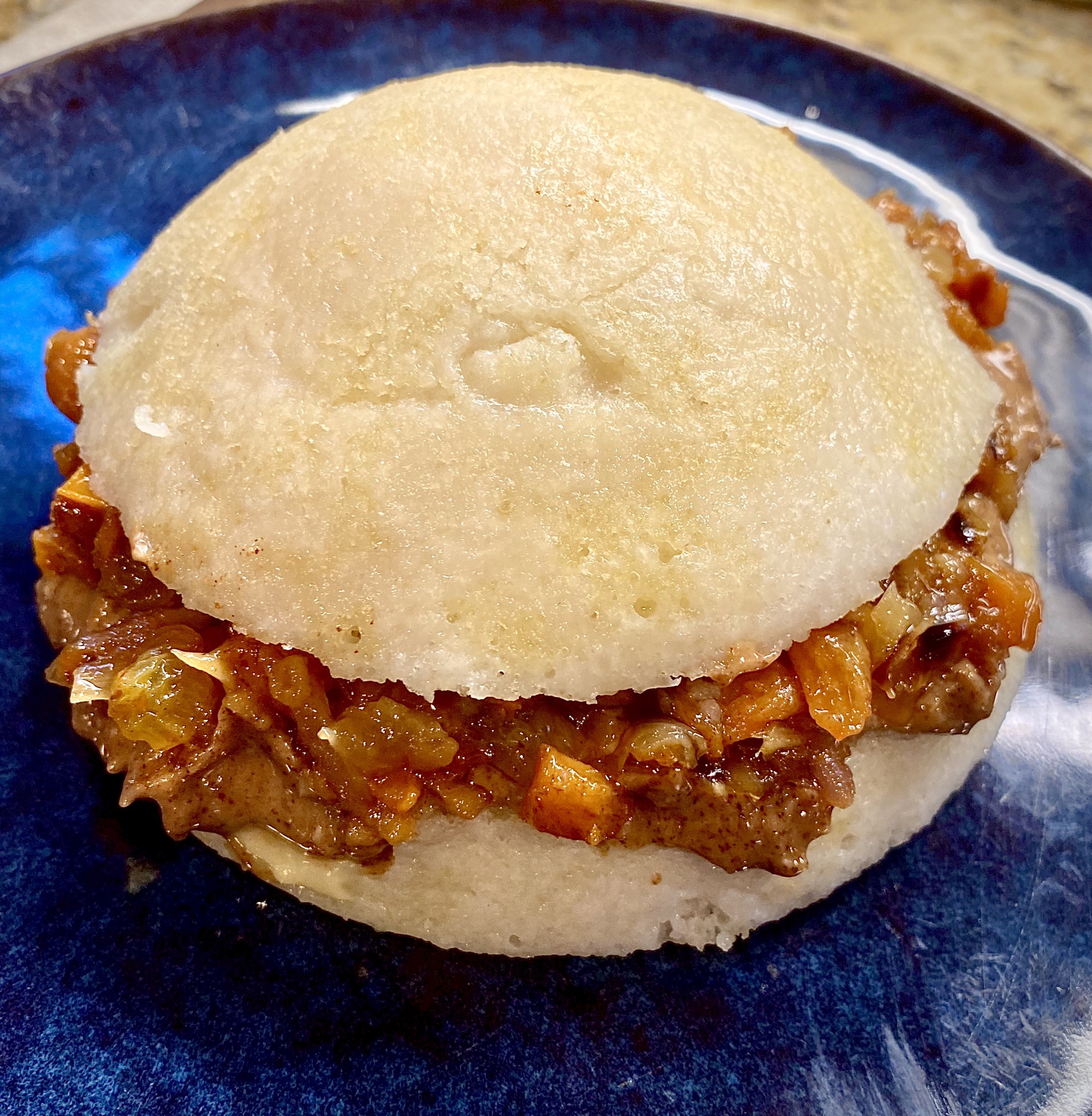
Idli with Almond Butter and Persimmon Chutney

Were I to tell you that this recipe is highly reminiscent of a peanut butter and jelly sandwich, you probably wouldn’t believe me, but it’s true. Idli, from Southern India, are soft cakey rounds that are oddly like white bread but pleasantly sour and made entirely from fermented rice and beans. Almond butter is more nuanced than peanut but either would work well, and the chutney is infinitely more vibrant than jelly. Combining these ingredients also came to me entirely serendipitously. About a decade ago I planted a little persimmon tree at the corner of my house, where it received next to no light and even less water. I vaguely remembered it was there, but it never bore fruit and never grew. This past season we trimmed back nearby trees and fixed the sprinkler. I happened to be poking around in front of the house mid October, and what do you know? Three gorgeous fuyu persimmons, crisp and sweet and ready to go on the idli I had just steamed for breakfast.

In terms of cost, I bought a large bag of basmati rice for $5.99 and beans $2.99. To make the idli batter, I used about a dollar’s worth of rice and 50 cents for the beans. The almond butter was already in the cabinet and the persimmon, free. So breakfast for me, just a cup of the batter, of which I had about 7 cups, so that means this cost 21 cents. I tested it a few times to get the cooking time right, so let’s be fair and say 63 cents to test and 25 cents for the other ingredients – a shallot and a few raisins, a spoon of almond butter. Eminently affordable, unusual, and quick. The only thing you need to start ahead of time is the batter, but it takes very little effort.

Idli

2 c basmati rice

½ c urad dahl (tiny white black gram beans with the outer coating removed – not lentils)

Spring water or filtered tap water

½ tbs butter

1 tbs almond butter

   Put the rice in one large bowl and the beans in another. Barely cover each with water. Cover with a dish cloth and allow them to ferment for 2 days. Next put them together in a blender and process until smooth and the consistency of cream. Return to the larger bowl and cover. Let ferment another two days, stirring a few times each day. Don’t be alarmed by any errant aromas the bowl may emit. It cannot go bad. It’s simply adjusting to your house and the lactobacilli are multiplying, fending off other bacteria. At this point it should be frothy and thick and resembles whipped egg whites. If your house is hot it may go quicker and the opposite if cold.

Then generously butter a small bowl about 4 inches in diameter and pour in some batter, about half way up. Place the bowl into a steamer and cook for 12 minutes. A smaller bowl will take a little less time, larger more. Remove from the steamer and let cool for a few minutes. Run a knife around the perimeter to loosen the idli and turn out onto a board. Slice the idli horizontally so you have a top and bottom, like a little bun. Spread the almond butter on one side.


Persimmon Chutney

2 tbs neutral oil

1 small shallot

1 knob of ginger

1 small fuyu persimmon

About 20 golden raisins

1 tbs vinegar

    When you put your idli in to steam, peel and chop the shallot and start to cook gently in the oil. Peel the ginger with a spoon, slice and dice finely, then add to the pan. Chop the persimmon finely and add. Likewise chop the raisins and add them. Splash with vinegar. Ideally this should be cooked just enough by the time your idli are done, about 12 minutes. Or let cook a few minutes longer if necessary. Put a good dollop of the chutney on top of the almond butter, close and serve up, just as you would a PB&J sandwich.


Friday, October 2, 2020

It's a Wrap

 I am fairly committed to writing a book about breakfast now. This very simple, quick and easy dish I made this morning has me excited to send out a proposal and get the ball rolling. I'm up to 16 recipes in the past few weeks, pretty much one a day. Well, here's a sample: 

The Thanksgiving Wrap

1 flat bread, home made or store-bought flour tortilla
2 tbs chevre
1 tbs umeboshi plum paste, found in a Japanese grocery
¼ c walnuts, crushed
1 tsp unrefined sugar
¼ tsp salt
1/8 tsp ground cinnamon
3 slices leftover turkey or roasted turkey cold cuts
1 tsp apple cider vinegar
1 tsp maple syrup
1 tbs walnut oil
Pinch of salt
Handful of baby spinach
 

Warm the flatbread over an open flame. Then spread with the chevre and squirt on the umeboshi paste. This is a stand in for cranberry sauce, it’s more sour, salty and sits in the wrap better. Spread it around evenly. Heat the crushed walnuts in a nonstick pan with the sugar and salt and cinnamon, stirring constantly and being careful not to let burn. Transfer to a plate to cool. Then sprinkle on the flatbread. Add the slices of turkey. In a small bowl mix the vinegar, syrup, oil and salt to form a dressing. Add in the spinach and mix with your hands. Then transfer to the flatbread. Roll up the bread tightly, cut on the diagonal and serve at once. 


Thursday, September 10, 2020

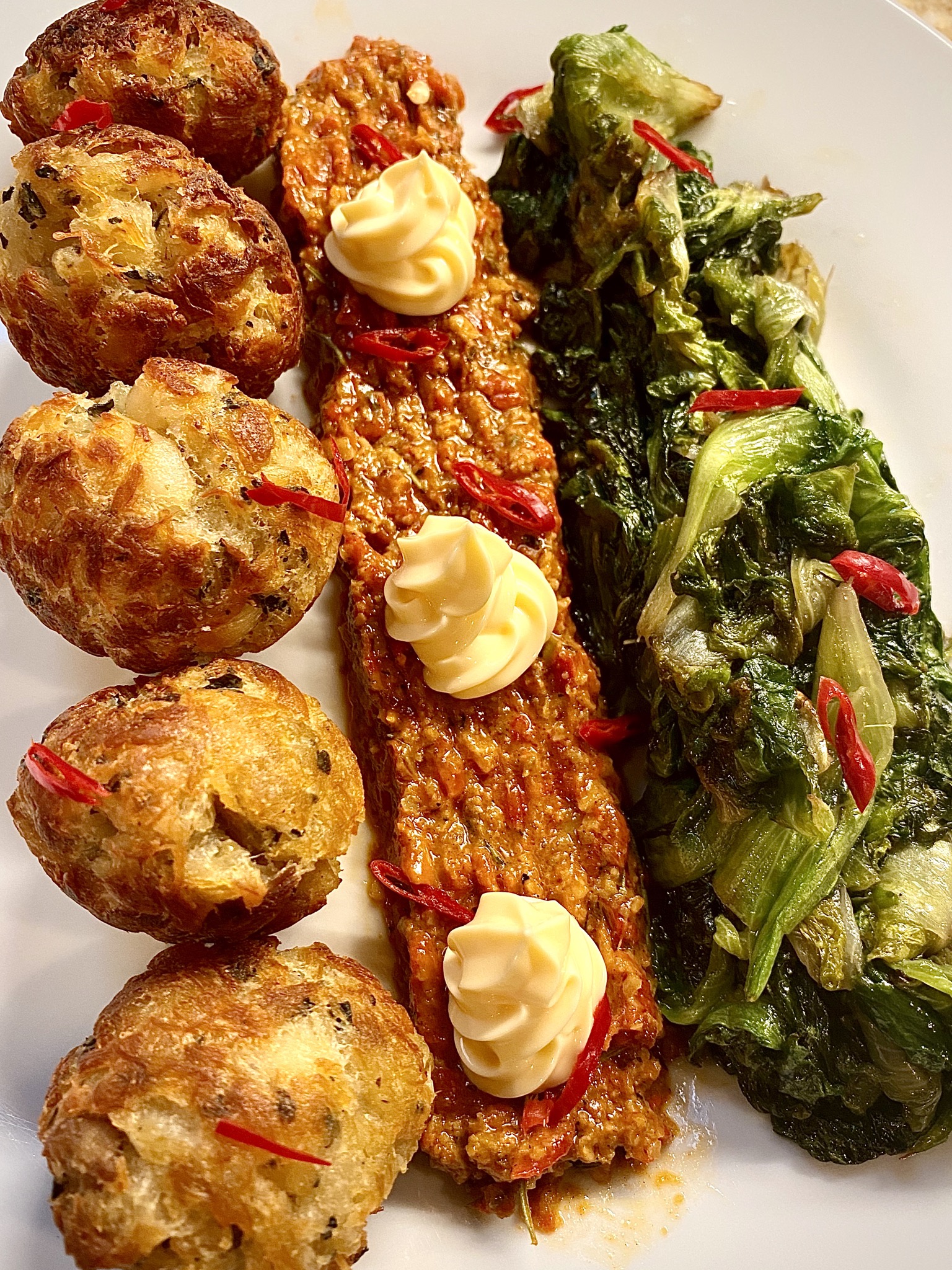
Salt Cod Fritters with Romesco and Escarole


Makes one dozen fritters

1 lb box of bacalão (salt cod)

2 tbs olive oil

¼ c heavy cream

½ c dry fino sherry

1 c okonomiyaki flour or regular pancake mix, plus more if necessary for a very thick batter

1 tbs lard or butter


2 large red peppers                                                    

½ cup toasted almonds, crushed                      

2 cloves garlic


¼ c olive oil

1 tsp salt

1 head of escarole

2 tbs olive oil

Salt to taste

Dabs of mayonnaise

1 thinly sliced small hot red chili pepper

 Soak the bacalão in water for 24 hours in the fridge, changing the water often. Sauté it gently in olive oil until it begins to fall apart, then transfer to a bowl. Add the cream and the sherry and mix until the fish has broken up completely. Then add the okonomiyaki flour. With your hands roll the batter into a dozen small balls and fry in a pan with hemispherical depressions such as an abelskiver or Takoyaki pan, or simply fry in a regular nonstick pan. Fry until golden brown and then transfer to a rack to cool.

Place the red peppers directly on the gas burner or grill and turn frequently until completely charred. Place in a large paper bag until cool. Scrape off the char with a knife, do not rinse, remove the seeds and core, and chop the pepper finely. Place in a pan with the garlic and olive oil and cook gently until soft. Add salt. Then transfer to a mortar and pound until it becomes a chunky sauce.

Chop the escarole and sauté in the oil until tender. Add salt to taste while cooking.

To serve arrange the fritters on a plate with the sauce and the escarole on the side. Garnish with the mayonnaise and slivers of chili pepper.


Tuesday, August 25, 2020

Jello Drinks to Beat Summer Heat


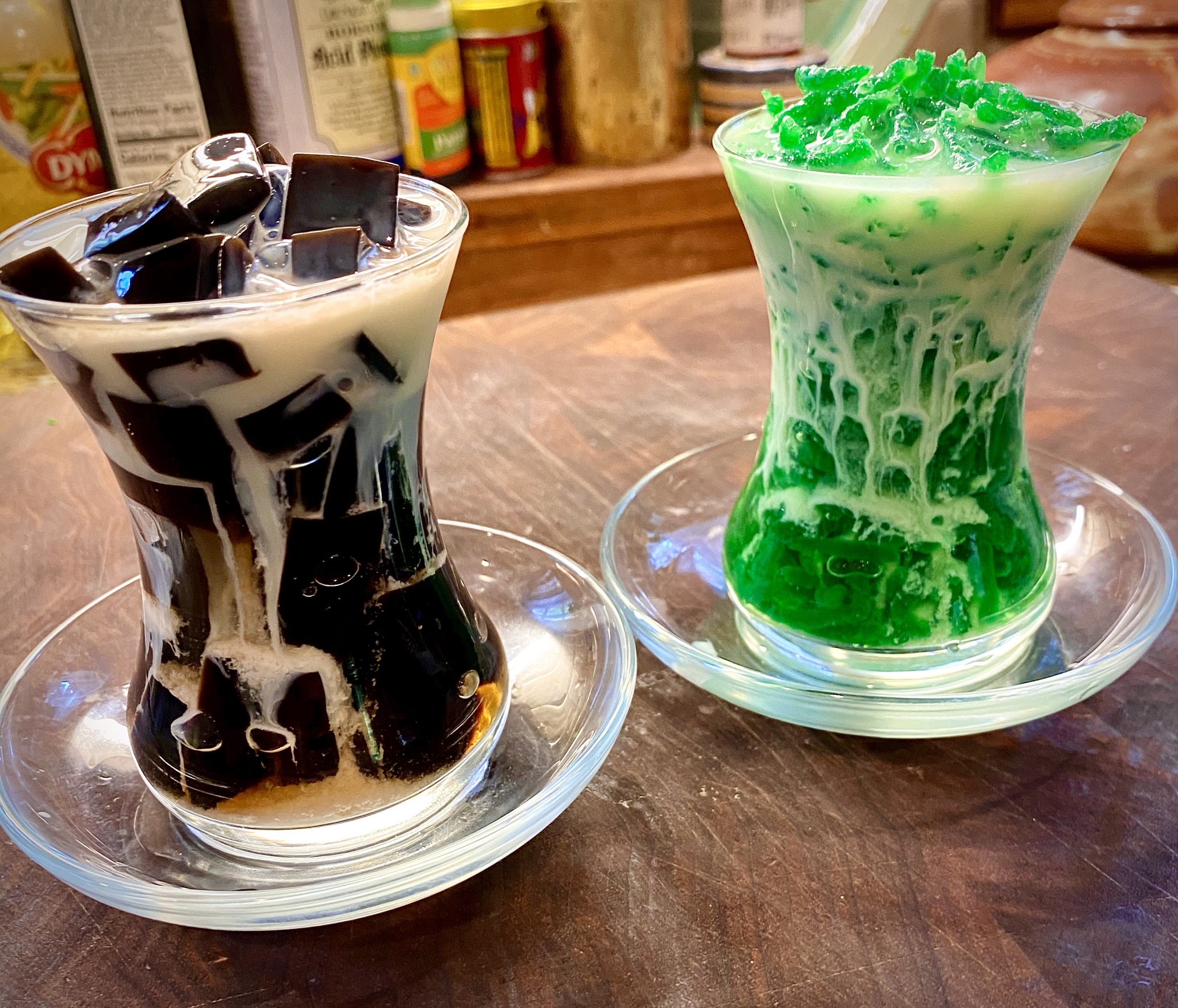
When the heat lingers for weeks on end, these Southeast Asian inspired jello drinks are seriously refreshing. The dark one is grass jelly cubes in white vermouth and sweetened condensed milk. The green is a pandan mung bean noodle in ice cold sake, also with sweetened condensed milk. I'm not sure why jello is so cooling in this form, but it sure is.